



























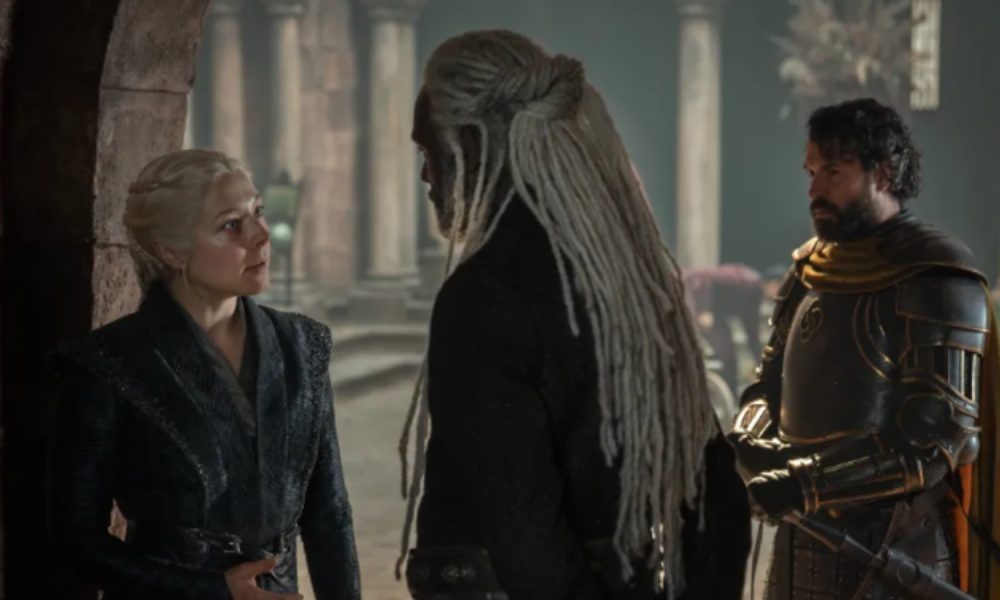
House of the Dragon Season 3 Episode 3 centers on Queen Rhaenyra Targaryen’s refusal to legitimize Corlys Velaryon’s sons, Addam and Alyn, a decision that directly fractures trust within the newly reclaimed Red Keep. This political denial becomes the immediate trigger for Corlys Velaryon’s public breakdown, where he openly refers to Rhaenyra’s own children as “bastards” inside court walls, exposing a fragile alliance that had been carefully maintained until now.
The clash transforms personal grievance into open political confrontation, as questions of inheritance and legitimacy begin reshaping the structure of power in King’s Landing. Actor Steve Toussaint describes Corlys’ reaction as a collapse of restraint shaped by exhaustion, grief, and long-buried frustration, while Emma D’Arcy’s perspective highlights how rulership depends heavily on perception and “optics of legitimacy.” Together, these viewpoints frame a single rupture that begins with refusal and escalates into public accusation.
Quick Read:
- Rhaenyra refuses to legitimize Addam and Alyn Velaryon
- Decision triggers breakdown in Velaryon loyalty
- Corlys publicly calls Rhaenyra’s sons “bastards”
Rhaenyra’s refusal that breaks Velaryon trust
Credits: HBO
Queen Rhaenyra Targaryen’s refusal to legitimize Addam and Alyn Velaryon forms the emotional and political trigger for the episode’s central conflict. Until this moment, Corlys Velaryon had maintained a fragile but steady alignment with Rhaenyra’s claim to the throne, even publicly defending her sons despite persistent rumours surrounding their lineage. However, the rejection of his request breaks that long-standing alignment and forces him into a public confrontation within the Red Keep.
Add WoT as a preferred source on Google.
Steve Toussaint describes Corlys’ state of mind at this breaking point as one where restraint no longer holds weight. “It’s one of the things that he does without thinking,” Toussaint tells Variety.
“Looking at the scene in the script, I remember thinking, ‘OK, well, the last time someone said that to her, it was his brother, and he died within seconds.’ So this is a very dangerous thing to do, but I feel like he’s completely at the end of his tether. In that moment, he doesn’t care, which, again, is why he raises his voice. It’s not like he sort of just goes, ‘I know what’s going on.’ He screamed it out. He doesn’t care. And it’s very defiant: I dare you to prove me wrong, because the world has suspected this anyway, and I’ve kept a secret. It’s not careless abandoned, that’s not quite what it is. I think it’s like, do your worst. I don’t care. There’s nothing you can do that will make the truth any different to what it is.”
The moment transforms personal disappointment into public accusation, shifting the political atmosphere inside the court and exposing how quickly alliances can collapse under the pressure of legitimacy and pride.
Legacy pressure and the cost of political legitimacy

Image Credit: HBO Max
The emotional foundation behind Corlys’ demand lies in his concern for House Velaryon’s continuation, especially through Addam and Alyn. His insistence on legitimization reflects not ambition alone but a long-standing fixation on preserving lineage in a world where inheritance defines survival. Toussaint explains that Corlys has reached a stage where fear of death no longer guides his choices, only legacy does.
“Now that always stayed with me for these last few years, because it meant to me that he wasn’t afraid to die, and that death was always near him, but he always had reasons to live, his children, his wife, and so forth,” Toussaint says. “But at this stage now, those people don’t exist anymore. The only thing that he’s got going, the only thing that’s keeping him going is, I need to set up these two boys. So when he says to her, ‘So and so is a bastard,’ and if she had said, ‘Right, let’s get the guards and we’re going to cut his head off, he would have been like, ‘Fine, that’s fine, this is as good a way to go as any.’ So I think it’s almost liberating to live with that idea that I don’t fear death, actually, because I’ve done everything in this world, I’ve done it all. So if my life ends today, fine. I guess his only concern, and it has been since Season 1 is to make sure the line, the Velaryon line continues.”
Emma D’Arcy further reinforces how legitimacy functions as political architecture rather than personal recognition:
“It’s actually a problem to have commoners riding dragons, not least because it undermines her image as rightful ruler.”
“In order to become a legitimate leader, you have to embrace the optics of legitimacy.”
Together, these perspectives underline why Rhaenyra’s refusal carries consequences beyond family politics, affecting how authority itself is perceived across the realm.
Also Read: House of the Dragon director credits Emma D’Arcy for emotional Rhaenyra and Daemon scene