













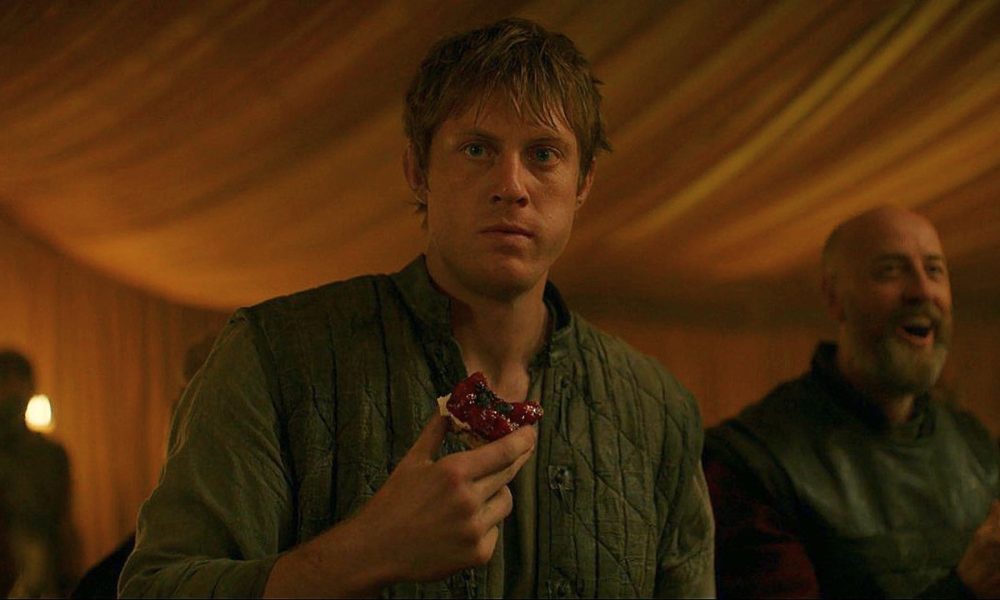
In HBO’s A Knight of the Seven Kingdoms, Ser Duncan the Tall (Dunk) breaks every stereotype of what a knight should be. Played by Peter Claffey, Dunk is a massive, awkward hedge knight from the slums of Flea Bottom, as revealed in the show’s latest episode. He’s over seven feet tall, clumsy in social situations, and his armour is makeshift, complete with a rope for a belt. He carries the weight of his rough upbringing.
Quick read:
• Episode 5 director Owen Harris comments upon Dunk’s unconventional knighthood
• He says Dunk lacks the “finesse” of a knight
• Dunk’s knighthood is based on the smallfolk perspective
Owen Harris’ opinion of Dunk’s knighthood
Director Owen Harris, who directed the entire episode 5 and some parts of the Trial of Seven, discussed this in the official Game of Thrones AKOTSK podcast for episode 5. During the conversation with podcast hosts Jason Concepcion and Greta Johnsen, Harris explained why Dunk’s untraditional knightly appearance is central to the story.
He says,
“He doesn’t look like a knight… He’s got none of the finesse of what you’d imagine a knight to look like, but he has these qualities.”
Harris highlighted how Dunk is different from the romanticized image of knighthood seen in songs and tales. Those stories paint knights as skilled warriors. However, according to him, Dunk lacks that usually signature “finesse.”
Harris described how Dunk carries an inner nobility that sets him apart, even though his outward appearance doesn’t match the traditional ideal. He noted that Dunk possesses a genuine sense of honour and goodness, yet he bears none of the sophistication one might expect from a knight. The character has real moral depth, but it shows through his actions rather than any surface charm.
Steffan Hill/HBO
The director emphasized that according to him and the show, authentic knighthood has little to do with birthright or inherited status. To truly claim the title of a knight, a person must live by a strict “moral code”; one that demands courage when the stakes are high. Many would back away from situations that risk serious injury, humiliation, or worse, but Dunk steps forward anyway.
Harris saw this as a fresh and compelling angle on chivalry and knighthood, told from the viewpoint of someone from the smallfolk rather than the highborn elite. In this story, knighthood is not handed down to him by someone. Rather, he is trying to earn it through difficult choices and sacrifice. That hard-won path, he said, is one of the most enjoyable and meaningful aspects of the entire narrative.
“It’s about taking on a moral code. You know, most people wouldn’t, when push comes to shove,
they might shy away from the thing that could end up with them getting beaten or their hand chopped off or whatever. So it was just an interesting way to look at the idea of chivalry
and knighthood in a way, from that sort of small folk perspective, which is what we’re talking about in terms of a knight. It isn’t something that is inherited or is given to you. It’s something you gotta earn, and you’re gonna earn it the hard way. And I thought that’s what is a really fun part of this story.”
This perspective shines throughout the series yet. Dunk’s rough edges make his commitment to protecting the innocent, and standing against cruelty feel earned and authentic. Whether he’s defending a wronged puppeteer in the Trial of Seven or quietly guiding his young squire Egg, his decisions reveal a knight code rooted in decency rather than privilege or appearance.