





Set roughly 90 years before the events of the original series, this HBO adaptation of George R.R. Martin’s The Hedge Knight novella follows the adventures of the lowborn hedge knight Ser Duncan the Tall (Dunk) and his squire Egg. The show’s six-episode first season, with shorter runtimes around 30 minutes each, culminates in a thrilling Trial of Seven in Episode 5.
This tournament pits 14 knights against each other in a fight to the death, marking a historic victory for Dunk; the first lowborn winner in a century. Yet, behind the scenes, showrunner Ira Parker revealed how severe budget constraints shaped this sequence into one of the most exhilarating and visually striking moments in the franchise’s recent history.
Quick read:
• A Knight of the Seven Kingdoms had far less budget than its predecessors
• Ira Parker revealed how smartly his team made use of production assets
• Real-time action was used more than VFX
Embracing budget limitations smartly
In a recent interview with CBR, Ira Parker was candid about the financial realities of producing A Knight of the Seven Kingdoms.
He said,
“We don’t have a lot of money on this show. We have about a quarter for every dollar.”
This stark comparison to the budgets of Game of Thrones or House of the Dragon meant the production couldn’t afford the spectacle of thousands of extras filling a grand tournament field. However, instead of viewing the limitation as a hindrance, Parker and his team turned it into an asset.
“It’s funny how not having any money just forces you to find really cool creative ways that maybe you wouldn’t have come to completely if you had just had the ability to spend it.”
He devised that the key was strategic misdirection, which meant carefully hiding what wasn’t there while making it feel seamless on screen.
Credit: HBO
Fog as a narrative and practical tool
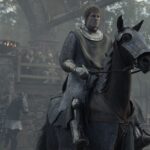
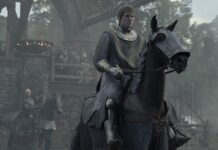
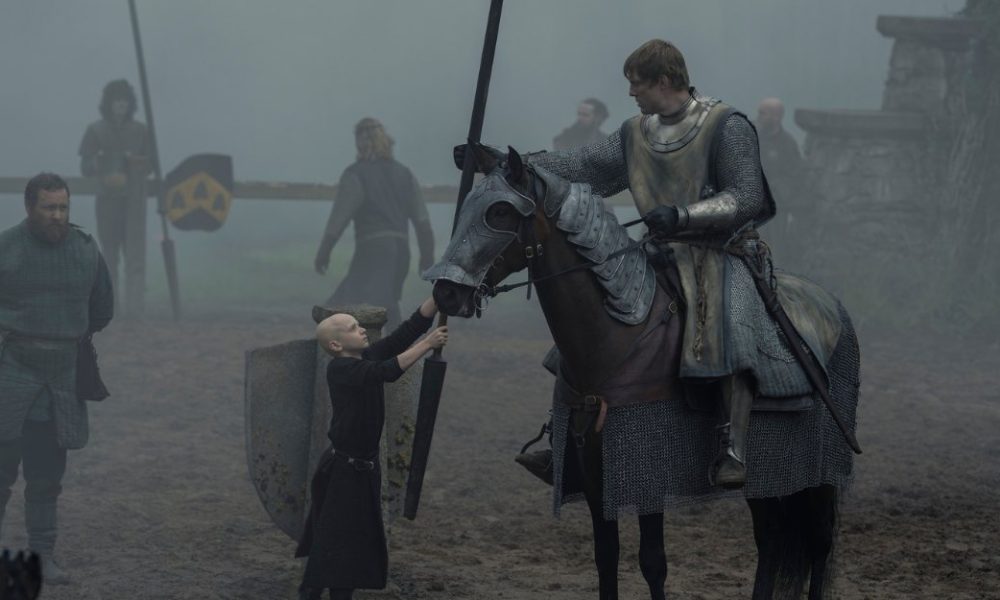
The Trial of Seven takes place on a foggy morning at Ashford Meadow, a detail drawn directly from Martin’s novel. Parker and his collaborators “embellished a lot of the fog” to enhance its visual impact and practical utility. The thick mist not only created a moody, atmospheric “badass looking fight,” but it also concealed the background, allowing the production to avoid showing a sparse crowd.
“We had to be careful how we hid things and how we made it feel like we weren’t hiding things. We let you focus on what we want you to be focusing on rather than not having a crowd of 10,000 people.”
By immersing viewers in Dunk’s restricted perspective through innovative camera angles like through-the-helmet shots, the sequence keeps attention locked on the intense combat rather than the absent spectacle. These helmet POV shots convey Dunk’s physical and emotional strain: peripheral vision narrowed by heavy armor, labored breathing echoing inside the helm, and heart heavily pounding. Parker emphasized how they wanted the audience to feel like they are in the fight.
This choice of Dunk’s limited vision being repeatedly highlighted through the eye-slit, smartly tackles the other issues on the set.
Creative collaboration and faithfulness to the source
Working with polished stunt coordinators and second unit directors, the team maximized in-camera action with minimal reliance on extensive VFX. The fog, helmet perspectives, and focused framing turned potential weaknesses into strengths, delivering an immersive experience.
Despite the limitations, the fight sequence was praised for its intensity and visual flair, with the episode earning a 9.9 IMDb score, which is one of the highest for the franchise ever. By leaning into creativity, atmosphere, and character-driven immersion, Ira Parker and his team transformed budget challenges into a win.