




















With the imminent approach of Game of Thrones’ eighth and final season, it is only fitting that as we look forward to the resolution of the show, we also take the time to turn back to the beginnings of the series. In order to properly appreciate an ending, especially for a show as intricate as GOT, it is a necessity to take an accounting of what has changed and what has remained the same over the years.
While the reemergence of magic, the change of seasons, and the endless list of murdered characters serve as flashy reminders of how the show’s plot-line has evolved and grown, an examination of the characters and relationships that were first established in Season One and remain going into Season Eight can illustrate new truths about the heroes we are cheering for, and the villains we are decrying. Ostensibly, Game of Thrones’ creators have always been emphatic about the very lack of such “black and white” moral alignments for their show’s characters, but these dynamics are unmistakable, not only as we go into the final season, but also in some of the very first scenes of Season One. Audiences’ perceptions of whether and how such characters, relationships, and alignments have changed will have a profound affect on what kind of story we are to infer it is that GOT is ultimately telling.
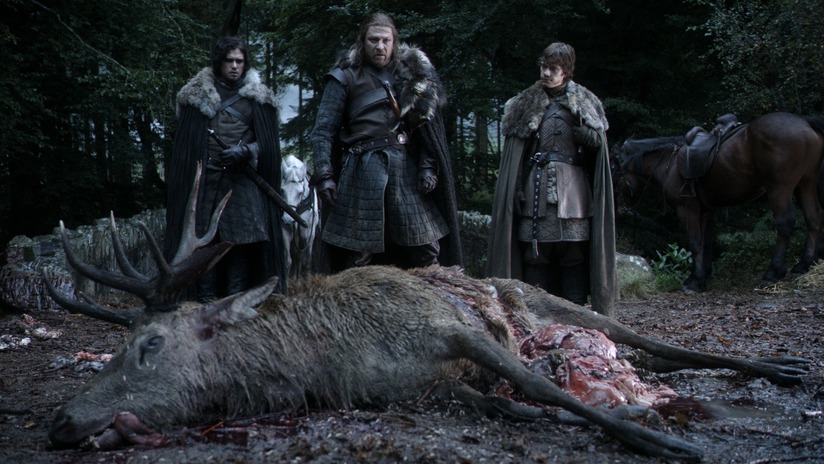 As is fitting for the pilot episode of one of the most popular television shows at the moment, Game of Thrones’ very first episode, “Winter is Coming,” has many memorable scenes which establish newly introduced characters, and their places in the world so thoroughly and effectively that they still act to characterize them today— take for instance, Daenerys’ gift of dragon eggs, or the shocking attempted murder of Bran Stark by Jaime Lannister. Another striking example of such a scene takes place early on in the episode when the Starks, on the way home from an execution, stumble upon a dead direwolf and her orphaned pups. What follows instantly characterizes the Starks as warmhearted, and caring in a cold and unforgiving world.
The young Bran Stark, who has yet to lose the use of his legs, believes he and his siblings should take the feral creatures home and raise them—after all, not only are they undeniably adorable, but they are also the Stark sigil in the flesh. Theon Greyjoy, the hostage ward of Eddard Stark, is not so nurturing— in his opinion, the wolves are freakish monsters that are best sequestered to the frozen tundras beyond the Wall. The Starks’ master-of-arms, Rodrik Cassel, echoes his concerns—“They don’t belong down here,” he says, “better a quick death.”
Theon over-eagerly takes out his dagger and wrenches a pup away from Bran before Jon Snow ultimately puts an end to the would-be puppy execution. Jon Snow also finds an overlooked pup in the snow—small, albino, and defenseless–and decides to take it home. If the audience didn’t already have a nagging suspicion that Theon was an unpleasant fellow after the puppies’ close brush with death, the Greyjoy,who never gets a wolf at all, but somehow ends up tasked with lugging two or three back to Winterfell, exits the first real scene where he has had any dialogue in the show with a biting comment aimed both at Jon, and the sad little puppy. What kind of a vainglorious brute threatens and then insults puppies? It’s easy to say that Jon walks away looking merciful, and Theon walks away looking cruel.
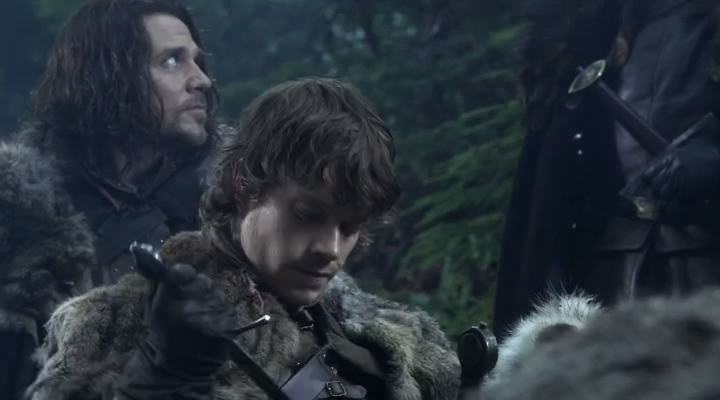 On the contrary, torn from his home and his family at a young age, and constantly under the threat of execution by Ned Stark, Theon has far more in common with the frightened, displaced wolf pups than he may realize, the difference being that while they adapt and thrive, at least for a bit, in their unnatural environment, Theon’s entire life is defined by a struggle to belong in a world that rejects him. Not being a cute, fuzzy puppy who grows up to be loyal, fearsome beast, Rodrik Cassel’s sentiment that those that don’t belong are dangerous and better off dead never stops haunting Theon, even as it is quickly disregarded in relation the wolves (Indeed, Rodrik, who taught Theon swordplay as a child, expresses a similar sentiment regarding Theon moments before the prince executes him—“I should have put a sword in your belly instead of in your hand.”) While the Starks successfully tame their wolves on a basis of trust and inclusion, Theon, whom the Starks treat more as a stray that they call family but then warily keep cloistered in a cage, can never reconcile the expectations that those around him have to be both unshakably savage and yet, unquestionably docile, and he ricochets between extremes for far too long, all the while increasingly convicted that everyone would prefer him dead.
Meanwhile, Jon Snow’s wolf, Ghost, matures into something exceptional and formidable, right beside Jon. Ghost is a testament to Jon Snow’s boundless compassion, a force with which he can turn emaciated pups into loyal companions, and fat, frightened boys into White Walker slayers; Jon can unite peoples that have mistrusted each other for years, and win a bloody battle for a sister who never treated him with love in his youth. Yet, none of this boundless compassion is evident when Jon and Theon, separated since Season One, are reunited in Season Seven.
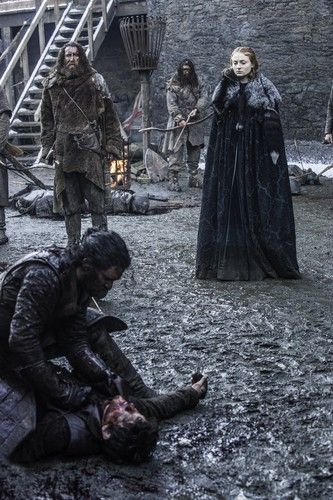 While Jon and Theon have remained quite separate for the majority of the show, this is in large part due to Theon Greyjoy’s longstanding, and largely legitimate conviction that should he come across the man he spent the majority of his formative years with, Jon Snow will kill him on sight, much as one would dispatch a rabid wolf. In Season Two, having irreversibly severed his ties with the Starks, exhausted his options, and the goodwill of his sister, Theon is informed that unless he wants to die, he has no recourse but to pack his bags, flee a band of angry Northerners, and head to the Wall.
“Join the Night’s Watch,” the kindly Maester Luwin urges him, “Once a man has taken the Black, he is beyond reach of the law. All his past crimes are forgiven….The Night’s Watch is an ancient, honorable order, you’ll have opportunities there.”
“The opportunity for Jon Snow to cut my throat in my sleep!” Theon retorts, so he stays where he is, and avoids that Snow, though not another.
Four seasons later, Theon once again has nowhere to go, and Sansa urges him to join her at the Wall. Theon is still firm on the matter: “Jon would have me killed the moment I step through the gate,” he tells her, and takes off alone, into the treacherous woods.
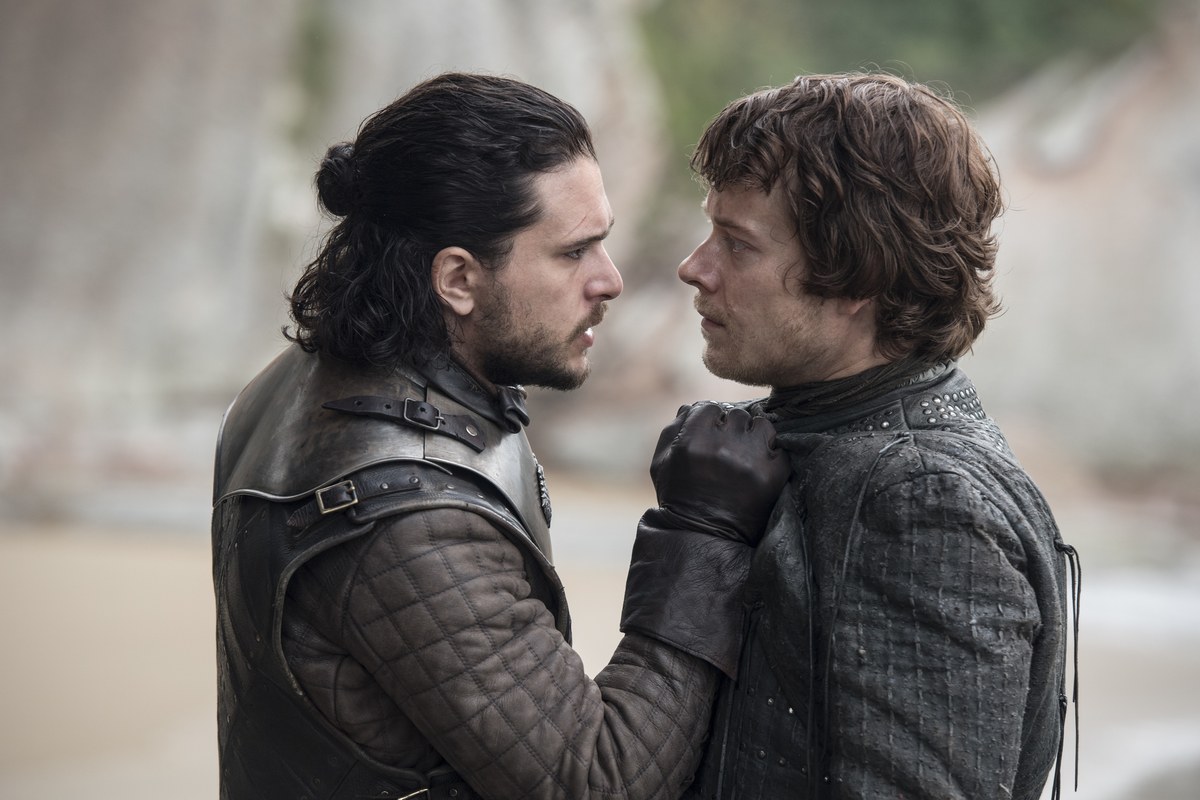
All this is to say that when, through a matter of coincidence and misfortune, Theon finally does come across Jon, Theon can at least be vindicated in the good sense of having avoided his half-foster-brother for so long, when without saying a word, Jon lunges for his throat.
For all Theon knows, Jon Snow, with his sword, and his shining armor, and his friends at his back, is about to kill him—weaponless, exhausted, and surrounded by mutineers. While Theon knows nothing of Jon’s intentions, interestingly Jon knows a great deal about him— including the facts that he did not in actuality burn Jon’s family home, or slaughter his brothers, misinformation which has been widely dispersed and unsuccessfully refuted for the most part. Moreover, Jon also knows that Theon did, on multiple occasions, risk his life for Sansa.
And yet, with all this knowledge, maturity, experience, and wisdom–qualities that so many would argue Jon has and Theon lacks, Jon cannot find an ounce of compassion for someone he grew up with, whom his brother loved as a friend, and to whom his sister owes her life. Interestingly, such compassion was easily mustered up time and time again for direwolf pups, wildlings, criminal members of the Night’s Watch, and all sorts of unsavory and unusual creatures in past seasons. Instead, Jon chooses to execute his own crude, physical brand of justice, one which has no founding in the laws of any larger legal, religious, or moral system other than the whims of Jon’s own emotions. In other words, he forcibly grabs Theon Greyjoy, who is in the midst of inquiring after Sansa’s well-being, snarls in his face, and shakes him by his lapels.
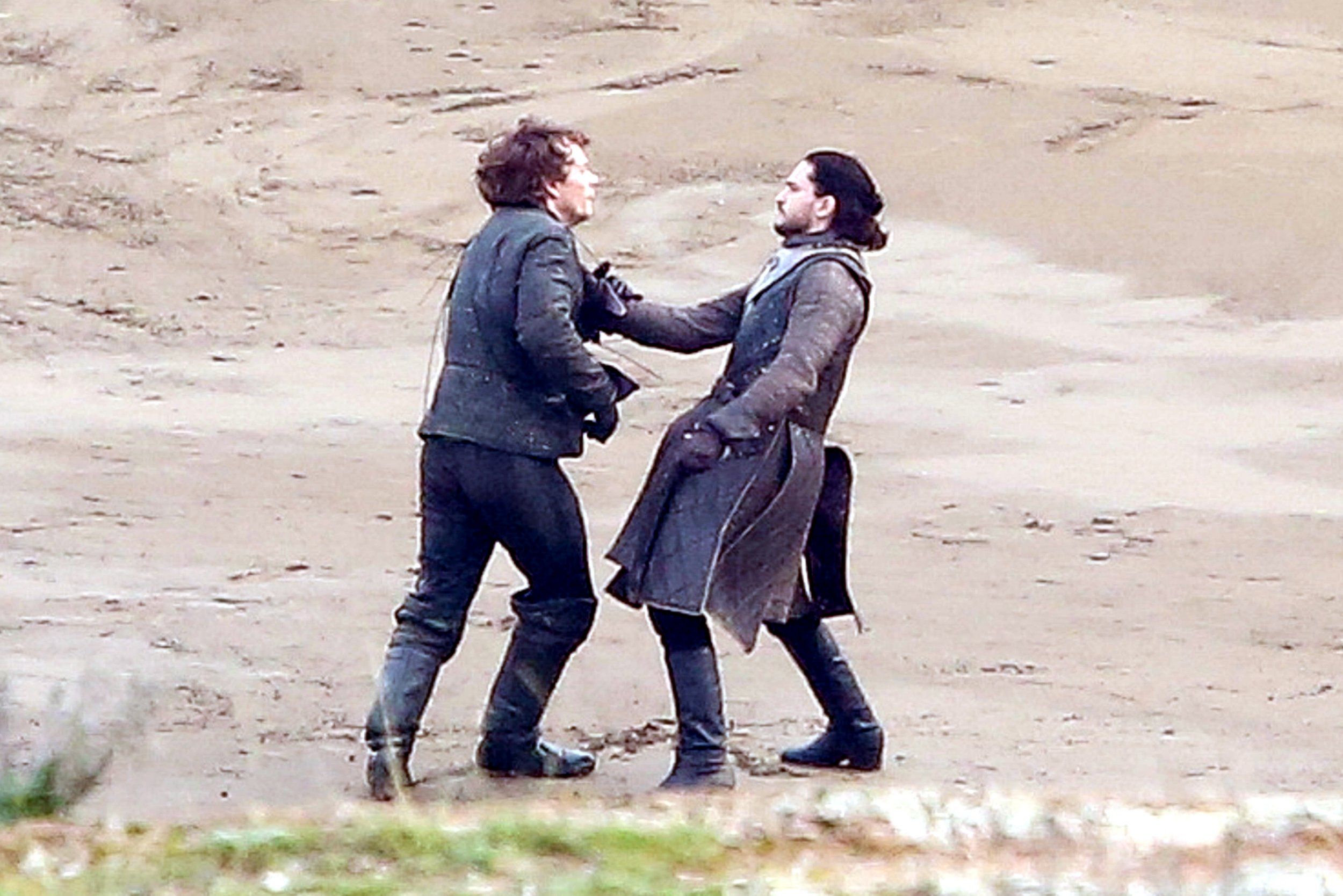
Such a over-the-top, physical assault on someone who is not being threatening in any manner, and whom Jon knew perfectly well has a troubled history with being brutalized, is the thing you expect from a schoolyard bully, and not the King in the North. But Jon just expects Theon to be grateful that he didn’t cut his throat. The scene is not one that most seem to value as a definitive turning point for either character, but Theon’s dignified resolve in the face of Jon’s juvenile and unsightly blustering makes one question just who is the hero of this scene, and of this story.
To Theon Greyjoy, perhaps the quick death of a child, abandoned and far from home would be far more merciful than a life of hopeless estrangement and inevitable heartbreak. The Starks were confident in their belief that nurture could trump nature when it came to their wild wolves, but not with their nine year old Greyjoy hostage, whom they always treated with mistrust and disdain, and yet also expected to see them as his true family when they never returned the favor. Robb simply could not comprehend why Theon would want to fight on the side of his family, nor did he try to empathize, assuming only malice. Sansa, without even pausing to differentiate between Theon’s two familial loyalties, invokes the bond of family when she needs Theon’s help rescuing her, and in turn, Jon, while shaking Theon up and down like a naughty child informs him, “What you did for her is the only reason I’m not killing you.”
The truth of the matter is that while the Starks are often praised for their endless virtuosity, much of what they do that is good is done out of the same sense of self interest that so many people condemn Theon Greyjoy for, time and time again. Jon and Sansa seem to see Theon’s interactions with them as transactions of good and bad deeds, not acts of progression in a relationship. And yet, for all the rage that Jon seemingly feels for Theon’s “abandonment” of Robb and the general Stark family, Jon breaks his vows and leaves his own brotherhood of the Night’s Watch behind out of a sense of hurt and deeper familial obligation, motivations which eerily resemble those that drove Theon to “betray” the Starks.
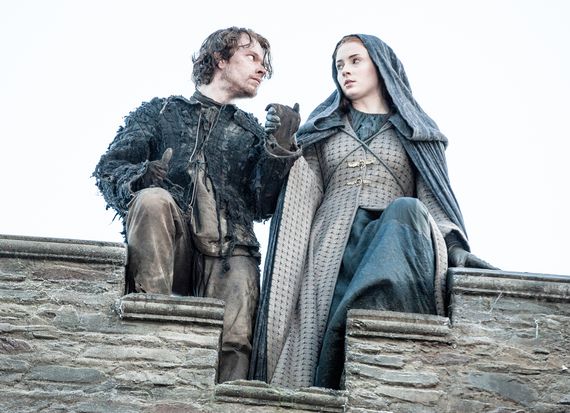 Theon doesn’t save Sansa to protect himself from Jon Snow (or anyone else for that matter), he does it out of a sense of love and loyalty that Jon doesn’t expect he should have to mirror when it comes to his childhood friend and honorary family member. If Theon’s relationship with the Starks is purely based on a clinical currency of favors, as Jon Snow would like us to think, then what did the Starks ever do for Theon that he should save Bran from a wildling and Sansa from a psychotic murderer? At the time of Bran’s rescue, all the Starks had done was offer a comfortable prison sentence. At the time of Sansa’s rescue, Sansa had endeared herself only by putting Theon in unnecessary danger and informing him that if she could, she would hurt him as badly as the very people he later saves her from did. Similarly, when Jon Snow finds someone he lived with for years, far from home, and menaced by an evil world, he finds it easier, and more satisfying to play the predator, resisting his primal sense of right to murder only because of some half-baked idea of redemption that might as well be based on a points system rather than on far more real, if less easily defined notions such as love and regret.
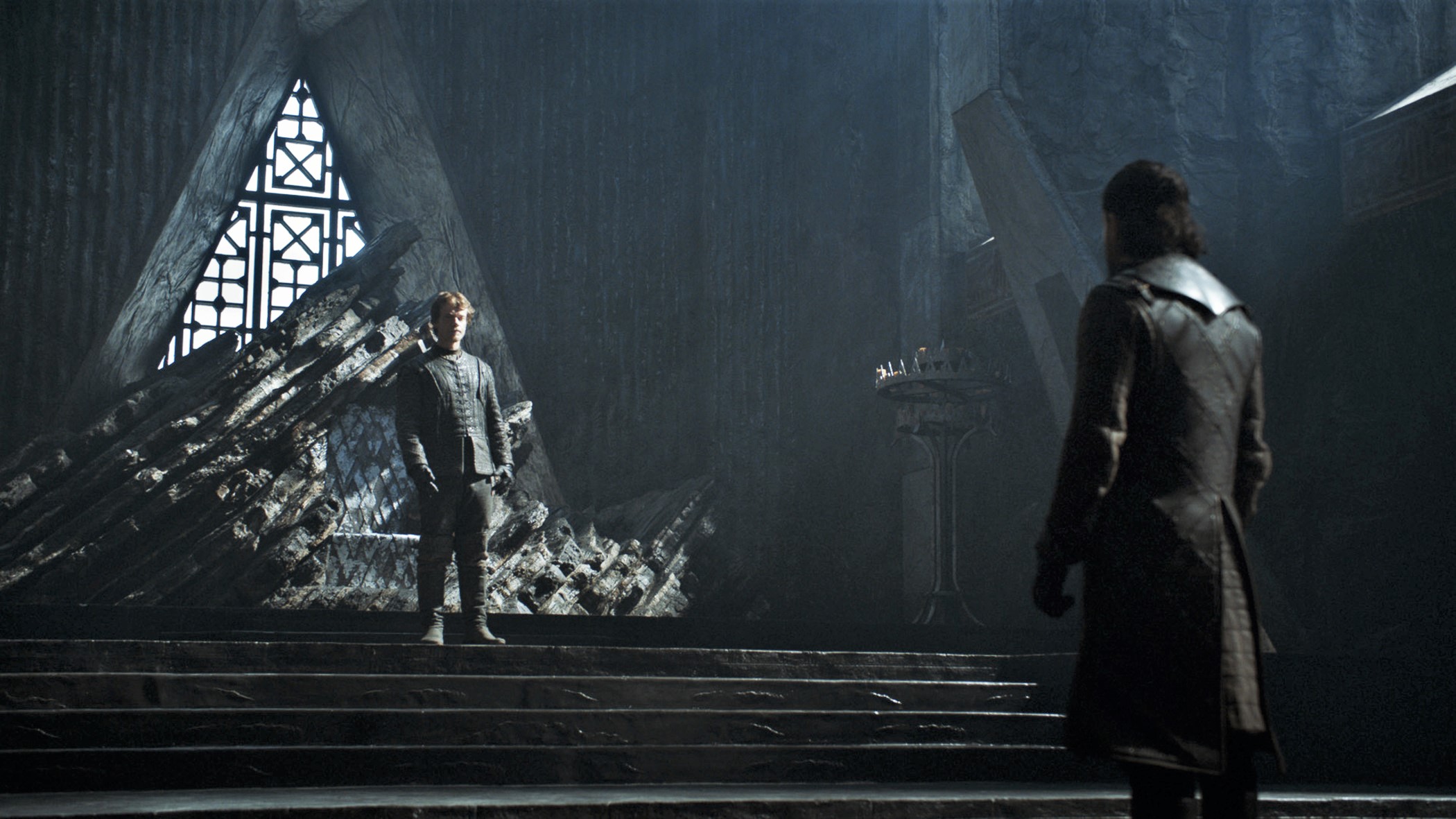
No sentimental musings in an empty throne room at a later date can change the fact that just as Theon Greyjoy had a choice when he found himself outside the gates of his former best friend’s defenseless castle, Jon Snow too had the privilege of choice when it came to how he would treat Theon Greyjoy on the beaches of Dragonstone. And like Theon Greyjoy in Season Two, he deliberately chose to be self indulgent and cruel.
Such a choice is just as ugly as anything Theon Greyjoy is ever critiqued for, but most audiences don’t struggle to understand that it comes from a place of deep emotion and hurt. The fact that Jon Snow’s rage is somehow more pure in the audience’s eyes than Theon’s own turmoil, which has fueled multiple thoughtless decisions that Theon has suffered deeply for, is something of a mystery, though much of the mystery can be solved from a brisk examination of Jon Snow’s cinematically stirring good deeds and his ability to seduce even the sternest of dragon queens.
Jon Snow’s life may be characterized by dazzling acts of morality that dominate the public memory as much as Theon Greyjoy’s acts of supposed maliciousness seem to do, but sometimes, small moments of unpleasantness or uprightness say more about a character’s true nature than a composite of their reputation. In its earliest years, Game of Thrones set out to be a celebration of those Tyrion Lannister fondly termed, “cripples, bastards, and broken things.” Though Westeros was often an unpleasantly cruel world, audiences returned again and again to cheer on underdogs like Jon Snow and Sansa Stark as they struggled to survive and rise above a frightening majority of bullies and oppressors that hemmed them in on all sides. Somewhere along the way, the bullied became became the bullies, but the cheers remained so loud, I’m not sure anyone noticed. As we wait to watch Season Eight, there is some uncertainty about whether the show will end on dark or more uplifting note, but in some ways, Game of Thrones has already set an irrevocable course for a tragic, and bitter ending.
Please feel free to leave a comment below.
For more on Theon Greyjoy, and his relationship with the Stark family, check out my previous article on the motif of the home in Game of Thrones.