



























Spoiler Alert: This article discusses major events from House of the Dragon Season 3, Episode 8.
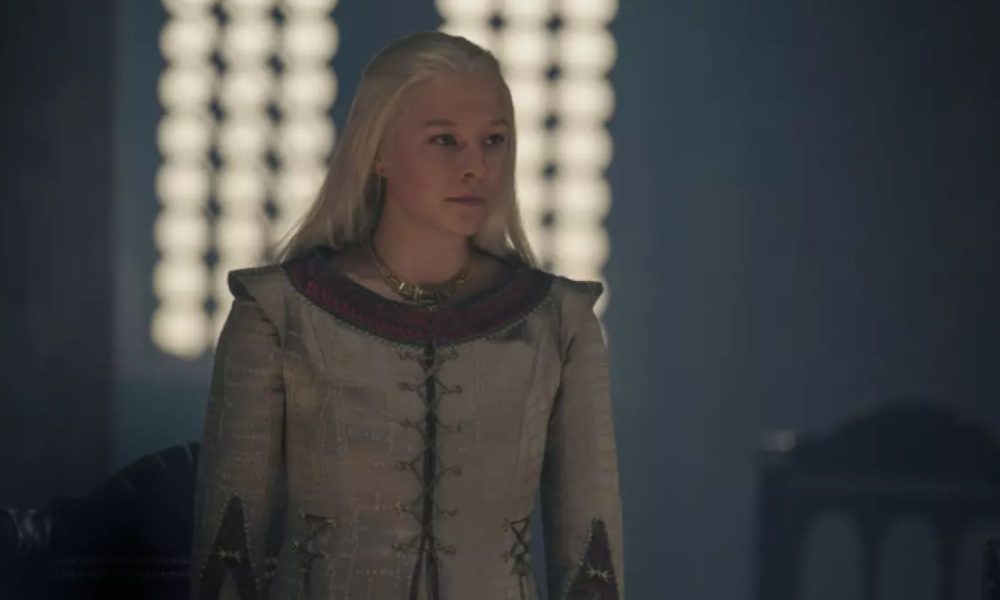
Rhaenyra Targaryen has spent much of House of the Dragon Season 3 trying to control what she says, how she says it, and what her position as queen demands from her. That restraint makes her High Valyrian conversations with Daemon especially revealing because the language gives Emma D’Arcy another way to express Rhaenyra without the stiffness that often comes with royal dialogue. By the Season 3 finale, that difference becomes even harder to ignore as Rhaenyra faces Aegon’s return, Helaena’s death, and the growing pressure surrounding her claim. The result is a version of Rhaenyra who sounds more personal, volatile, and emotionally exposed.
Quick read:
- High Valyrian gives Rhaenyra greater emotional freedom with Daemon.
- D’Arcy and Smith approach the language as part of their acting, not decoration.
- Episode 8 turns Rhaenyra’s private intensity into a public declaration.
High Valyrian lets Rhaenyra drop her royal restraint
Credit: HBO
What we found most fascinating about Rhaenyra’s High Valyrian dialogue is how much freedom D’Arcy seems to find in it. Rhaenyra spends so much of the season surrounded by people who expect a queen to measure every word, yet her conversations with Daemon have a different rhythm. There is more intimacy in them, and the language gives their relationship its own private space.
Add WoT as a preferred source on Google.
Emma D’Arcy explained on the official House of the Dragon podcast:
“Especially this season, it felt really, really apparent to me… that, well, certainly for Rhaenyra, spoken High Valyrian feels like a language that’s far more expressive and sort of emotional and kind of passionate.”
That description fits what we see from Rhaenyra, particularly when her emotions start getting the better of her judgment. High Valyrian allows D’Arcy to give the character sharper changes in tone and intensity, which makes Rhaenyra’s exchanges with Daemon feel less rehearsed and more instinctive.
Matt Smith offered another useful explanation:
“Because the form of the language in English is of a sort of certain period and rhythm, weirdly, adversely, the Valyrian allows you to be slightly more naturalistic in its performance.”
Daemon can be teasing, provocative, affectionate, or severe within the same conversation, while Rhaenyra can answer without sounding as though she is addressing a council chamber.
Season 3 finale makes Rhaenyra’s emotions impossible to hide

Credit: HBO
Episode 8 gives this choice greater significance because Rhaenyra has reached a particularly painful point in her journey. Aegon’s return creates another threat to her claim, while Helaena’s death leaves her confronting the human cost of the conflict around her. She is carrying grief and political pressure at the same time, and D’Arcy does not play Rhaenyra as someone who has everything under control.
That is what we liked about the finale. Rhaenyra’s emotions are allowed to be messy. She can be angry, frightened, determined, and uncertain without neatly separating those feelings for the audience. After spending so much time watching her behave in line with the expectations attached to the crown, seeing her speak with greater freedom feels overdue.
The finale also situates Rhaenyra’s belief in the Targaryen prophecy firmly within her political identity. Her declaration about the Song of Ice and Fire pushes her further toward the conviction that her claim carries a purpose beyond the immediate struggle for the throne.
Do you think High Valyrian brings out the real Rhaenyra, or is D’Arcy simply giving us another side of a queen who has been forced to hide too much for too long? Drop your theory in the comments below!
Also Read: Tea and biscuits were the disgusting secret behind the Tumbleton assassination scene