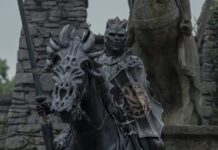
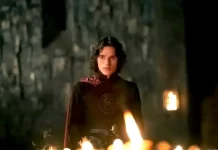
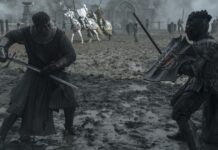
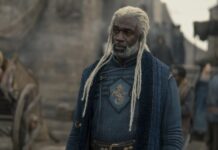




















In House of the Dragon Season 3, Episode 6 (“Faceless Men”), Ser Criston Cole finally met his end; and it was one of the most faithful adaptations of George R.R. Martin’s Fire & Blood the series has delivered so far.
The sequence, known in the books as the Butcher’s Ball, unfolds with brutal efficiency. Criston and his exhausted forces believe they have survived an earlier ambush by Rhaenyra’s troops, only to discover the real trap: the Winter Wolves led by Roddy the Ruin and the forces of House Tully surrounding them.
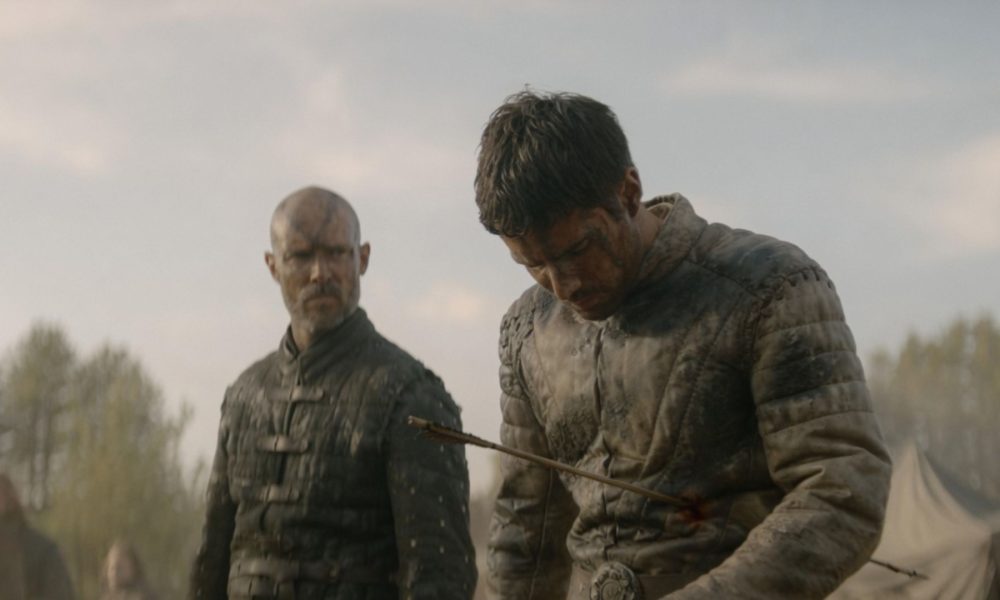
Determined to die a warrior’s death, Criston seeks a final stand in combat. Instead, Alysanne “Black Aly” Blackwood denies him that glory, shooting him full of arrows before the slaughter of his men begins in earnest.
Staying true to the source
In Fire & Blood, Criston Cole’s death is deliberately unheroic. Surrounded near the Gods Eye, he attempts to negotiate safe passage for his remaining soldiers and, when refused, challenges the enemy commanders to a duel. The lords reject the offer outright.
Archers (led by Red Robb Rivers in the book) cut him down with arrows to the belly, chest, and neck. No epic last stand. No songs of bravery. Just a swift, ignominious end for the man once called the Kingmaker.
Add WoT as a preferred source on Google.
Ser Criston Cole’s death in #HouseOfTheDragon. pic.twitter.com/PI7juoff7t
— westerosies (@westerosies) July 27, 2026
House of the Dragon preserves the spirit and structure of that moment almost beat for beat. The archer changes from Red Robb Rivers to Alysanne Blackwood, but the core remains identical: Criston is denied the glorious battlefield death he craves and is instead reduced to a body on the ground as the real battle erupts around him.
Actor Fabien Frankel, who portrayed Cole across three seasons, had read the relevant passages in Fire & Blood and understood what awaited his character. When showrunner Ryan Condal called to confirm the death, Frankel’s primary concern was fidelity to the books.
Telling Entertainment Weekly,
“I feel proud to be dead in a way. I never died on TV. I’d never died in anything until this. It’s my first-ever death.”
He compared the moment to iconic Game of Thrones exits like Oberyn Martell and Robb Stark; deaths that shocked audiences precisely because they refused traditional heroic framing.
An emotional sendoff for the actor
Frankel learned of his character’s fate while standing in line at the U.S. embassy in London to renew his visa. The news landed out of season and unexpectedly, though he admitted he “felt it coming.”
Months later, on his final day of filming, the death scene itself was shot under tight constraints, including a rushed 90-minute prosthetics session to place an arrow near his eye and proved more emotionally charged than he anticipated after five and a half years with the role.
Fabien Frankel says goodbye to the cast and crew of #HouseOfTheDragon pic.twitter.com/OKr71r7fVl
— Thrones Updates (@ThronesUpdates) July 27, 2026
Upon wrapping, Condal gifted him Criston’s helmet and sword, which Frankel now keeps in a spare room in his London flat.
In a series that has sometimes diverged significantly from the source material, Criston Cole’s death stands out for its accuracy. The show resisted the temptation to give the polarizing knight a more cinematic or redemptive final battle. Instead, it delivered George R.R. Martin’s vision.
Criston Cole’s fate may have been shocking to some viewers, but for those familiar with Fire & Blood, it was something rarer in the adaptation: a moment that felt exactly as the author intended.