


























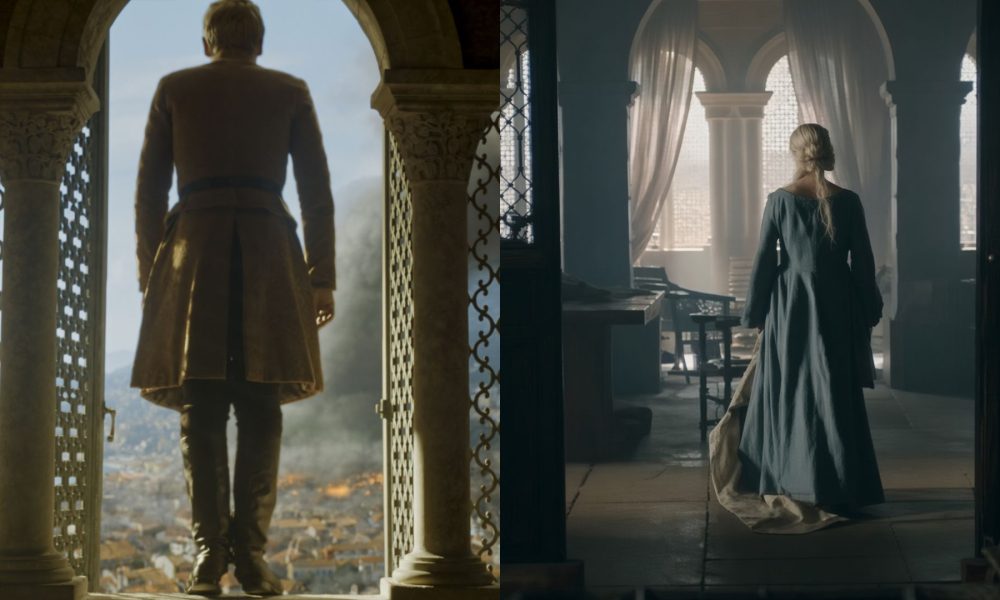
One of the most quietly haunting details in the House of the Dragon Season 3 finale is the window from which Helaena Targaryen (Phia Saban) leaps to her death. Many viewers immediately noticed a visual similarity to the window Tommen Baratheon used in the Game of Thrones Season 6 finale to commit suicide. The resemblance has has gotten fans talking about whether the parallel was intentional.
In an interview with Entertainment Weekly, both Phia Saban and showrunner Ryan Condal have now addressed the connection directly.
Quick read:
- Phia Saban wasn’t aware of Helaena’s death’s resonance with Tommen’s
- Showrunner Ryan Condal confirmed being aware of the parallel
- It was somehow a deliberate choice
The Dreamer is gone.
Helena Targaryen was one of the gentlest members of House Targaryen, a princess who never desired power or war despite being born into the family that would tear Westeros apart. She married her brother Aegon Il and became queen, having three… pic.twitter.com/I3RDbDbQBp
— Xerxes (@TheXerxesHQ) August 10, 2026
Phia Saban on the “meta” parallel
When asked whether the window was meant to be the same setting as Tommen’s, Saban responded with characteristic thoughtfulness.
Add WoT as a preferred source on Google.
“Interesting… I wonder. I don’t know if I would necessarily be in those meta-creative conversations, because I’m always trying as much as I can to focus on the inner life stuff, but I wouldn’t be surprised. There’s something quite interesting and meta about that, as well, isn’t there? About that history repeating itself, especially with the context of Helaena’s relationship to time passing and the inevitability of things. Maybe there is some cool parallels. Who knows? I don’t know.”
Saban’s answer talked about how well the visual echo fits Helaena’s character. As a dreamer who experiences time differently and often senses the weight of fate, the idea of history looping back on itself feels deeply appropriate. Even if the actress was not part of the production conversations about the set design, she recognizes the thematic resonance but can’t speak if it was actually a parallel.
Ryan Condal confirms the echoes
Credits: HBO
Showrunner Ryan Condal offered a clearer production perspective during a virtual press conference. He confirmed that the parallel was noticed and, to some degree, embraced.
“It’s a different set build in a different world, but echoes and reflections and parallels, for sure, to be drawn between the two series.”
His response carefully balances practical reality with creative intention. The window is not a reused set from Game of Thrones, yet the production was fully aware of the visual and thematic connections fans would make. The “echoes and reflections” language Condal frequently uses when discussing the relationship between the two shows suggests the similarity was welcome rather than accidental.
History repeating itself

Credits: HBO
The parallel carries extra weight because of who these two characters are. Tommen’s jump came after the destruction of everything he loved and the collapse of his sense of purpose. Helaena’s leap arrives after prolonged captivity, the loss of her children, the erosion of her family, and the crushing knowledge of what is still to come.
Both deaths are quiet, almost private acts of surrender. Both involve young people who have been used as political pieces and ultimately choose to exit a world that has become unbearable.
For a character like Helaena, whose visions constantly blur past, present, and future, the visual reminder of Tommen’s fate feels especially pointed. It reinforces one of the central ideas of the Targaryen story: that the same tragedies tend to repeat, generation after generation, even when the people involved believe they are making different choices.
A deliberate resonance
Whether or not every viewer is meant to catch the reference, the comments from Saban and Condal confirm that the similarity is not pure coincidence. House of the Dragon continues to weave deliberate connections to its predecessor through atmosphere, imagery, and the recurring patterns of power, grief, and fatalism that define both series.