



























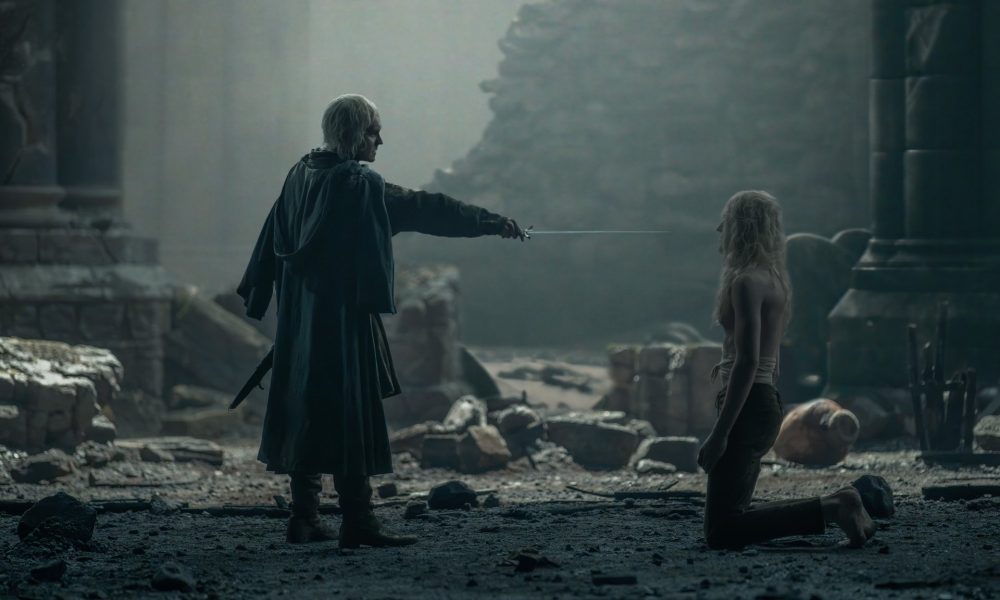
Showrunner Ryan Condal has explained why Aegon Targaryen chose not to kill Aemond in the House of the Dragon Season 3 finale, framing the decision as both a deliberate mark of character growth and a setup for the final season.
Speaking at a press conference as reported by Games Radar, the showrunner described the moment as the end of two sharply contrasting arcs: one brother improved by distance from power, the other altered by proximity to it.
Quick read:
- Condal says killing off Aemond just like that wouldn’t have been fun
- Aegon’s recent experience has made him realise Aemond is his strongest ally
- Season 4 simply sets up Rhaenyra & Daemon vs Aegon & Aemond
Aegon chegou de visita em Harrenhal pra estapear o Aemond kkkkkkkkkkk
O que eu acho? Acho é pouco.#HOTD #HouseoftheDragon pic.twitter.com/qdwJ7bI9hf— Lindley | Final Boy 👻 (@jlinzombie) August 10, 2026
The confrontation at Harrenhal
In the House of the Dragon Season 3 finale, Aegon (Tom Glynn-Carney), scarred, hardened, and recently reunited with his dragon, Sunfyre, arrives at Harrenhal and corners Aemond (Ewan Mitchell).
Add WoT as a preferred source on Google.
The younger brother had tried to kill him during the Battle of Rook’s Rest in Season 2. Instead of taking revenge, Aegon spares him, recruits him for the campaign to reclaim the Iron Throne, and leaves open the possibility of eventual forgiveness.
The scene is a show-original invention not detailed in Fire & Blood. Condal has noted that Aegon largely disappears from the historical record for a stretch, leaving room for such an encounter to have occurred off the page.
“That would be no fun”
Condal’s explanation is blunt: simply killing Aemond “would be no fun” and would have undercut the growth the writers spent the season building.
“He’s learned a lot in Season 3 here, Aegon. And even though he’s still angry with his brother and has agendas, I think what he realized in his evolution is that he does deserve a lot of the things that happened to him, probably in some way, and, had to learn how to be a better king.”
The experience of living among the people as a pauper, Condal argued, forced Aegon to confront what it actually takes to rule.
He continued:
“I think if Aegon had shown up and just killed Aemond, it really would not have marked the growth in the character. It’s him seeing Aemond’s change, and then realizing where he is standing with his dragon, and suddenly this incredible wind of legitimacy behind him… he’s experienced a messianic return. I think it would ruin and spoil that for him to kill the person that’s potentially his greatest and strongest ally.”
Credits: HBO
The season’s central irony
Condal framed the entire season around a pointed inversion. Aegon, removed from the orbit of the throne and forced to survive as a commoner, “goes on this incredible character evolution, where he becomes a much more dimensionalized man, who is more sympathetic and possibly more suited to rule.”
Rhaenyra, by contrast, remains close to power and is “turned and altered and somewhat corrupted by being in its orbit.” The result is a damaged but more complex Aegon who ends the season with Sunfyre at his side and Aemond (and Vhagar) potentially in his camp, while Rhaenyra’s hold on the throne grows more authoritarian.
Setting up House of the Dragon Season 4
Condal has described the core of the remaining story as centered on Rhaenyra and Daemon on one side and Aegon and Aemond on the other. Keeping Aemond alive preserves that dynamic and the narrative possibilities of the brothers’ alliance as the war intensifies.
The series is planned to conclude with Season 4 in 2028; the Harrenhal scene is explicitly intended to vault the story into that final stretch.